
Finally, support for the people who support transplant.
Proactively gather outside records, automatically extract key findings, and seamlessly automate administrative work.
As featured in


Cut administrative work,
not corners.
Proactively gather outside records
Carenostics monitors the outside health systems your patients touch and alerts your team to clinical events as they happen.
Automatically extract key findings
Carenostics reads the unstructured records behind each event and pulls out only the clinically relevant findings.
Seamlessly automate admin work
Carenostics files updates and assembles reports automatically, writing everything back to your EHR as structured data.
Made for the whole
transplant team.
Three roles drive the decisions. The whole team works from one record.

Coordinators
Carenostics clears the below-license work so coordinator time goes to patient care, not data entry.

Physicians
Carenostics keeps the patient picture complete and current at every check-in, so physicians have the full context at the moment they need it.

Surgeons
Carenostics makes sure the record is complete, verified, and current, including events at outside systems, at the moment the decision is made.
Stage 01 · Referral
Complete records from day one.
When a patient is referred, their clinical history is scattered across health systems. Carenostics gathers outside records from prior care facilities and surfaces the findings that matter for evaluation. The coordinator walks into the first call with a complete picture, not a scavenger hunt.
Potential impact: Up to 44% coordinator efficiency gain
Stage 02 · Evaluation
Committee-ready in one click.
Listing decisions depend on the full team having a verified, current view of the patient. Carenostics structures clinical data from across sources, extracts key findings for physician and surgeon review, and auto-generates selection committee reports with source links every reviewer can verify.
Potential impact: Up to 2x patients to committee
Stage 03 · Waitlist Management
No patient falls through the cracks.
A waitlisted patient's status can change at any time: a hospitalization at an outside facility, a missed lab, an expired test result. Carenostics monitors continuously, fires real-time alerts when action is needed, and keeps checklist data current. Annual check-ins and ongoing care requirements are tracked automatically, so coordinators spend their time on patients who need clinical attention, not on chasing down who is overdue.
Potential impact: Up to 30% more patients active, organ-ready
Stage 04 · Organ Acceptance
Confidence at 3am.
When an organ offer comes in, the team needs the most current picture of the recipient immediately. Carenostics ensures the record reflects everything that has happened since the recipient was last seen, including events at outside systems. The surgeon makes the call with verified, complete data.
Potential impact: 30 minutes per offer decision
Stage 05 · Post-Transplant Monitoring
A growing caseload that stays manageable.
Every transplant adds a patient to the post-transplant caseload permanently. Labs, medication adjustments, and follow-ups compound year after year. Carenostics monitors post-transplant patients continuously, flags overdue results and external hospitalizations, and surfaces complications before the next appointment. The caseload grows. The workload does not grow proportionally.
Potential impact: Caseload grows ~100 patients per year
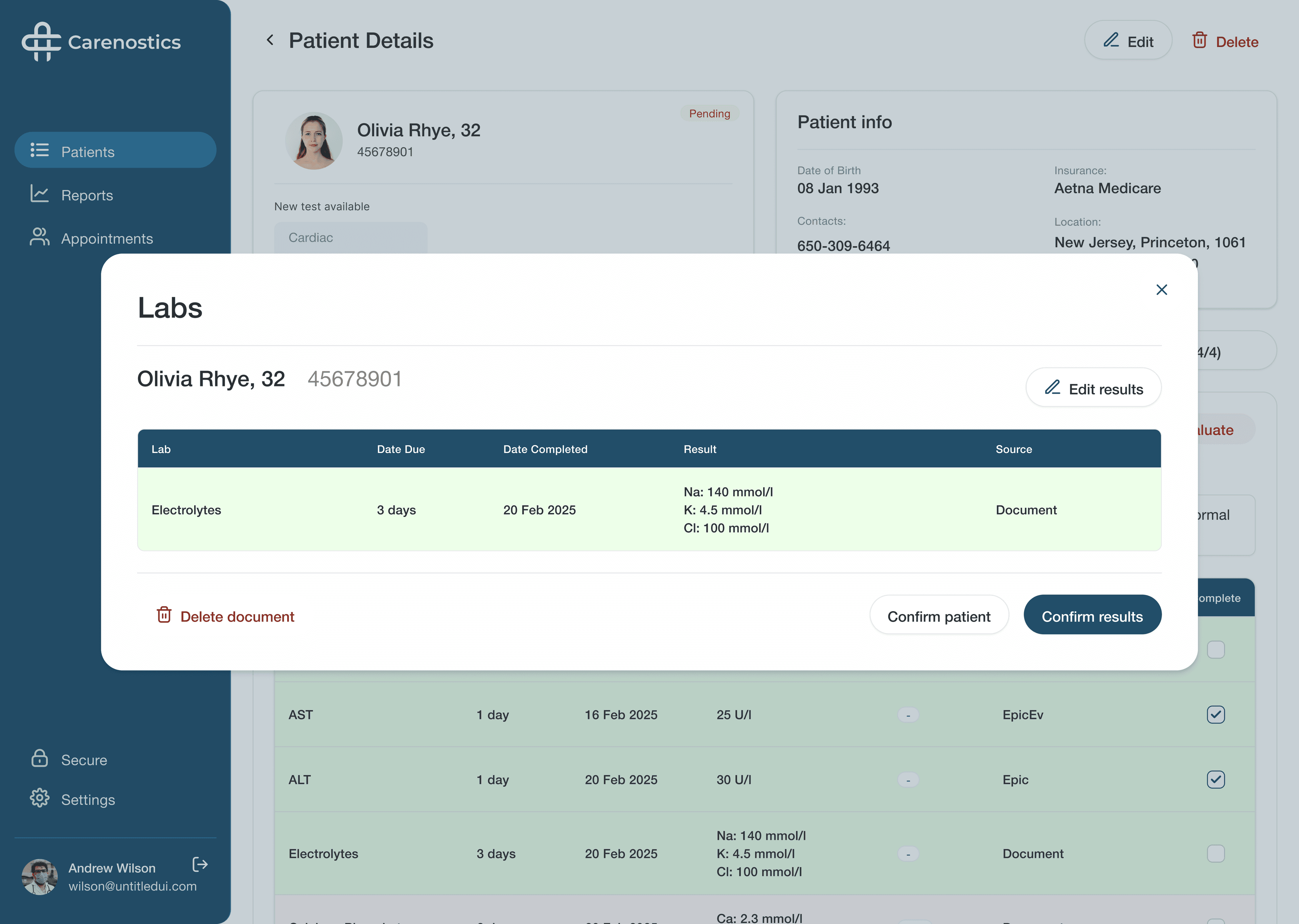
Stage 01 · Referral
Complete records from day one.
When a patient is referred, their clinical history is scattered across health systems. Carenostics gathers outside records from prior care facilities and surfaces the findings that matter for evaluation. The coordinator walks into the first call with a complete picture, not a scavenger hunt.
Potential impact: Up to 44% coordinator efficiency gain
Stage 02 · Evaluation
Committee-ready in one click.
Listing decisions depend on the full team having a verified, current view of the patient. Carenostics structures clinical data from across sources, extracts key findings for physician and surgeon review, and auto-generates selection committee reports with source links every reviewer can verify.
Potential impact: Up to 2x patients to committee
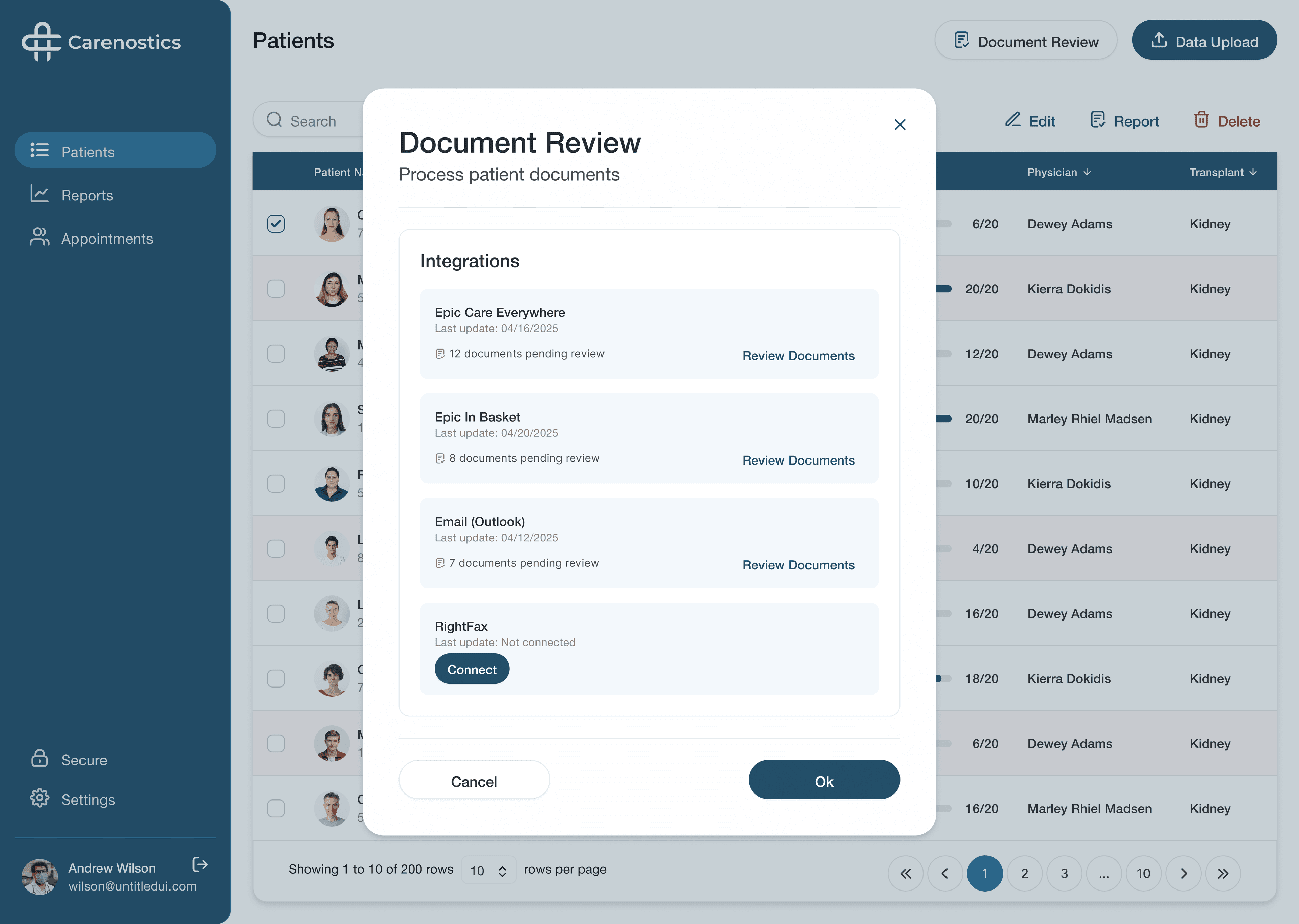
Stage 03 · Waitlist Management
No patient falls through the cracks.
A waitlisted patient's status can change at any time: a hospitalization at an outside facility, a missed lab, an expired test result. Carenostics monitors continuously, fires real-time alerts when action is needed, and keeps checklist data current. Annual check-ins and ongoing care requirements are tracked automatically, so coordinators spend their time on patients who need clinical attention, not on chasing down who is overdue.
Potential impact: Up to 30% more patients active, organ-ready
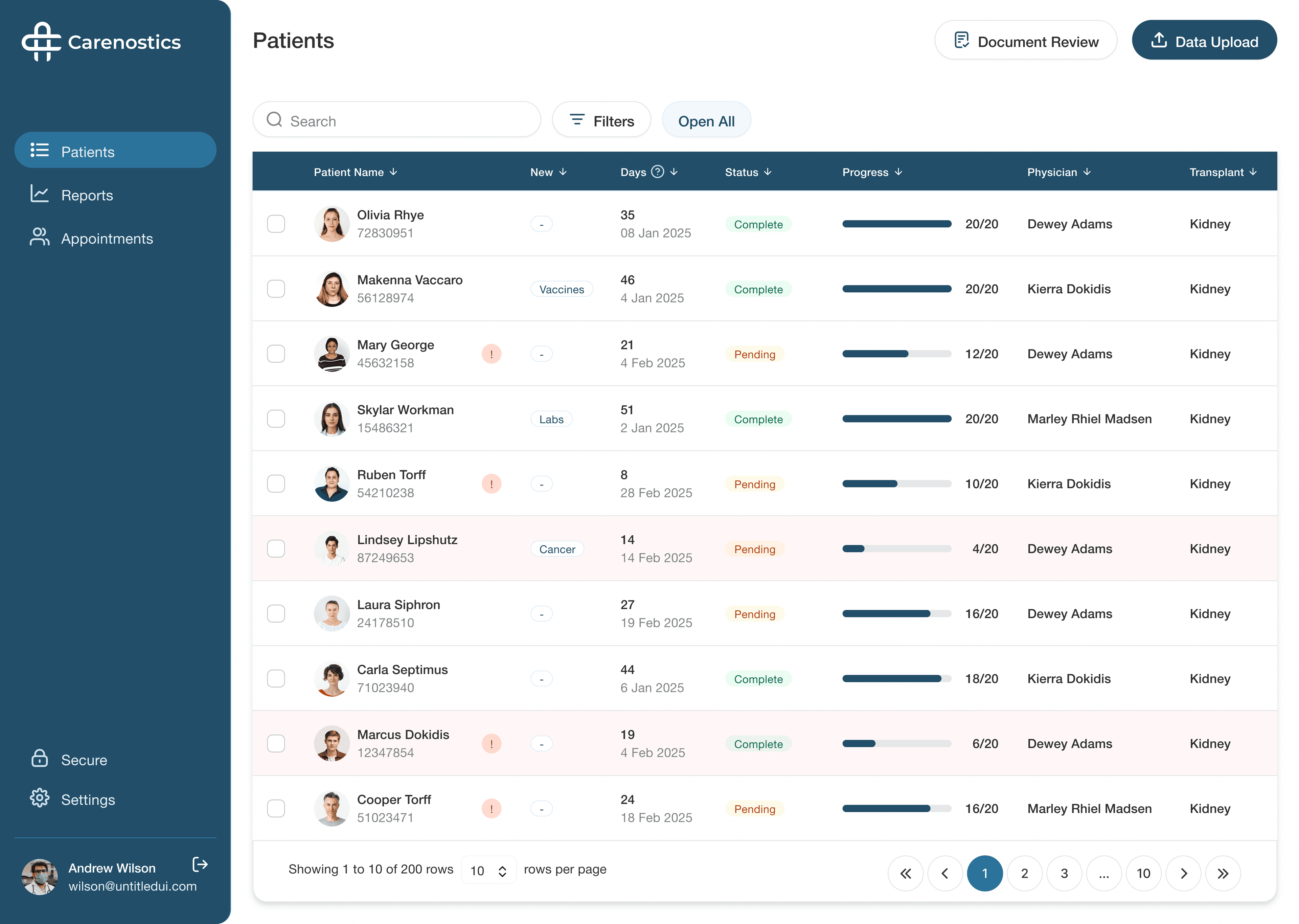
Stage 04 · Organ Acceptance
Confidence at 3am.
When an organ offer comes in, the team needs the most current picture of the recipient immediately. Carenostics ensures the record reflects everything that has happened since the recipient was last seen, including events at outside systems. The surgeon makes the call with verified, complete data.
Potential impact: 30 minutes per offer decision
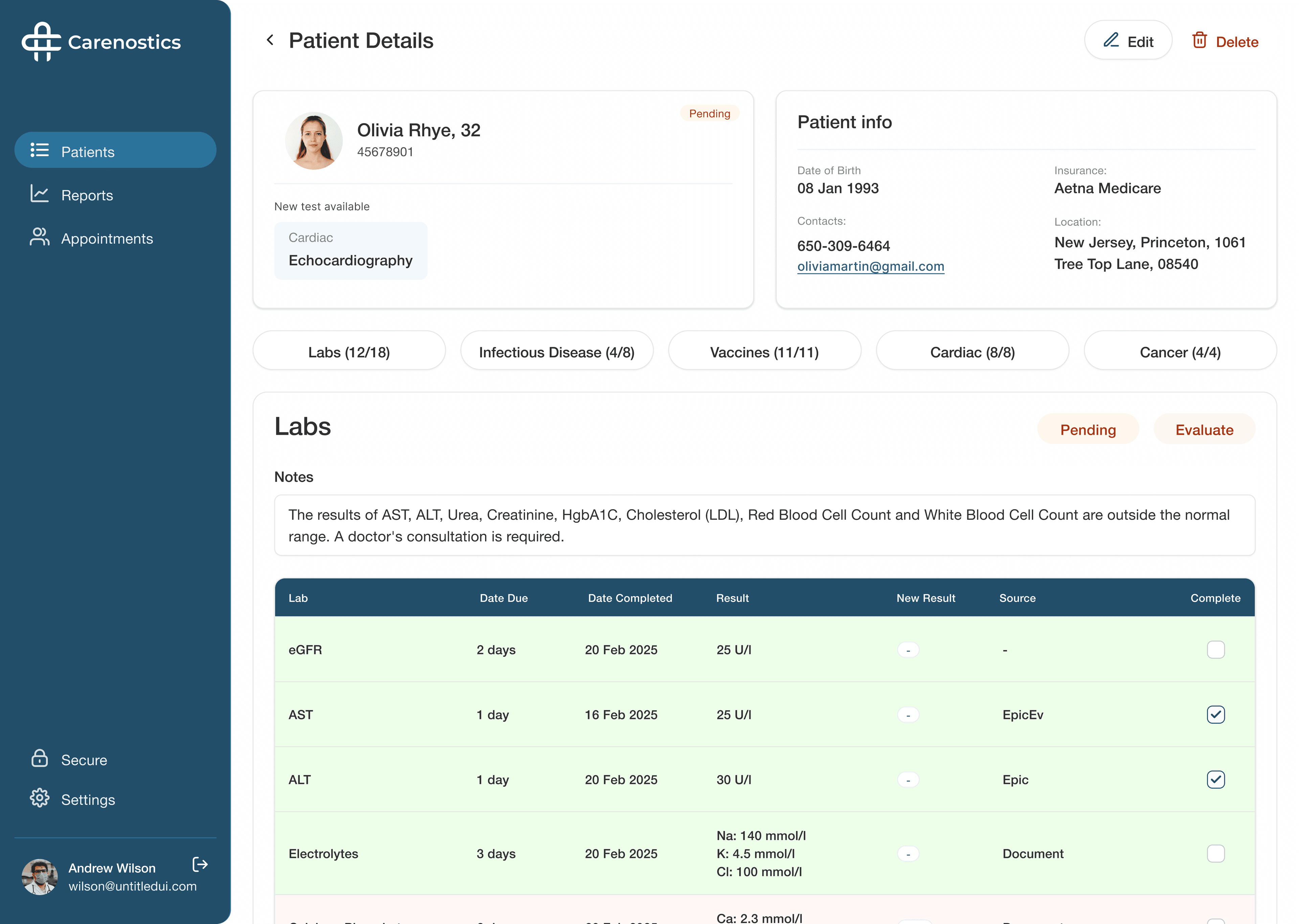
Stage 05 · Post-Transplant Monitoring
A growing caseload that stays manageable.
Every transplant adds a patient to the post-transplant caseload permanently. Labs, medication adjustments, and follow-ups compound year after year. Carenostics monitors post-transplant patients continuously, flags overdue results and external hospitalizations, and surfaces complications before the next appointment. The caseload grows. The workload does not grow proportionally.
Potential impact: Caseload grows ~100 patients per year
Growth you can pitch
on one page.
More transplants. Same team. Most of the cost comes back.
A larger active waitlist yields more transplants whenever organs become available. Each additional transplant represents hundreds of thousands of dollars in program revenue.
Carenostics clears administrative work from your existing team, delivering capacity equivalent to three additional coordinators. The reclaimed hours go to patient care.
Pre-transplant administrative infrastructure is reimbursable via the Medicare Cost Report. The reimbursable share varies by program; for most transplant programs it offsets a meaningful portion of contract cost.
Built with standards
your IT team expects.
Built for EHR workflows: SMART-on-FHIR, HL7
Integrates natively with major EHRs using industry standards. No custom interface builds, no additions to your backlog.
HIPAA-compliant, HITRUST-certified cloud
All data hosted on a HITRUST-certified healthcare cloud. Carenostics handles all compliance and security updates.
SSO, RBAC, full audit logging, zero local PHI
Supports enterprise IT protocols including Single Sign-On, Role-Based Access Control, and comprehensive audit trails.
Deploys alongside existing tools. No rebuilds.
Carenostics does not replace your EHR. It completes the picture your EHR cannot see and writes everything back as structured data.
See it for yourself.
Forty-five minutes. See the complete picture.